BLOG ON
People Are Visiting Your Website but Nobody Is Contacting You, Here’s Why
PUBLISHED ON - 13th September, 2026 · 7 min read
PUBLISHED BY

Aditya Prem Sharma
Product Specialist
Why Your Website Gets Traffic but No Leads
Your website is getting visitors. Google Analytics shows people are landing on your pages, reading your content and exploring your services.
But there is one problem.
Nobody is contacting you.
No enquiries. No calls. No WhatsApp messages. No form submissions.
If this sounds familiar, the problem may not be your website traffic. Your website may simply be failing to turn visitors into customers.
This is where website conversion optimization matters.
Note
Quick answer: A website can get traffic and still generate very few leads when the messaging, trust signals, user experience, calls to action, contact process or mobile experience are not strong enough.
1. Your Website Message Is Not Clear
The first question a visitor asks when they land on your website is simple:
What does this business actually do for me?
If your homepage makes visitors work to understand your service, they may leave before exploring anything else.
Your headline should communicate three things quickly:
- What you offer
- Who you help
- Why someone should choose you
For example, instead of:
We create digital experiences for modern businesses.
A clearer message would be:
We build high-performance websites that help businesses generate more enquiries.
The second version immediately explains the service and the expected business outcome.
This is especially important for visitors coming from Google search, social media, paid advertising or AI search results. They should immediately understand that they are in the right place.
What to check
Ask someone unfamiliar with your business to open your homepage for a few seconds.
Then ask:
"What does this company do?"
If they cannot answer quickly, your messaging needs work.
2. Your Calls to Action Are Too Weak
A visitor can be interested in your service and still leave because you never clearly tell them what to do next.
A website needs a clear call to action, or CTA.
Weak CTAs include:
- Learn More
- Explore
- Discover
- Submit
- Click Here
These do not always communicate what happens next.
More specific CTAs can reduce uncertainty:
- Get a Website Quote
- Book a Consultation
- Discuss Your Project
- Request a Free Consultation
- Talk to Our Team
Your CTA should also appear naturally throughout the website rather than only once at the bottom.
Tip
A good CTA answers the visitor's next question: "What should I do if I am interested?"
For example:
3. Visitors Do Not Trust You Enough
People rarely contact a business website simply because the website looks attractive.
They need a reason to believe that the business can actually deliver.
This is where trust signals become important.
Your website can build trust through:
- Client logos
- Real project examples
- Case studies
- Testimonials
- Reviews
- Team information
- Certifications
- Industry experience
- Clear contact information
- Professional business details
- Relevant portfolio work
If you claim to provide professional web development but your website has no examples of your work, visitors have little evidence to evaluate you.
Show, do not just tell
Instead of saying:
We build high-quality websites.
Show the websites you have built.
Instead of saying:
Our clients love working with us.
Show genuine testimonials.
Instead of saying:
We understand your industry.
Show relevant projects and examples.
This is one of the biggest differences between a simple website and a conversion-focused website.
4. You Are Giving Visitors Too Many Choices
More options do not always mean more conversions.
Sometimes they create confusion.
A website might have:
- Multiple services
- Several menus
- Numerous buttons
- Different offers
- Multiple contact methods
- Several competing messages
The visitor then has to figure out what they should do.
A better approach is to create a clear path through the page.
Your website should guide visitors toward the most important action without making every element compete for attention.
For example, a service page could focus primarily on:
| Page element | Primary purpose |
|---|---|
| Headline | Explain the service |
| Benefits | Show why it matters |
| Portfolio | Build trust |
| Process | Reduce uncertainty |
| CTA | Encourage enquiry |
| Contact form | Capture the lead |
This does not mean your website should have only one button.
It means your primary conversion goal should be obvious.
5. Your Contact Form Is Losing Leads
A visitor may decide they want your service and still abandon the enquiry because your form asks for too much information.
Consider the difference.
Long form
- Full name
- Company name
- Job title
- Phone
- Company size
- Industry
- Budget
- Project type
- Detailed requirements
- Preferred timeline
Simple form
- Name
- Email or phone
- What do you need?
The right form depends on your business, but every field should have a purpose.
If you are asking for information that you do not immediately need, consider removing it.
Warning
Every additional field creates another opportunity for a visitor to abandon the form. Keep the first enquiry as simple as your sales process allows.
Also make sure the visitor understands what happens after submitting the form.
For example:
We will review your requirements and contact you to discuss the project.
That small message can make the process feel more predictable.
6. Make Contacting You Extremely Easy
Not every visitor wants to fill out a form.
Some prefer WhatsApp.
Others want to call.
Some prefer email.
Your website should make the appropriate contact methods easy to find.
Depending on your business, consider providing:
- Contact form
- Phone number
- Consultation booking
- Business location
The important thing is not to display every possible option everywhere.
Instead, make the preferred contact method obvious.
For businesses that receive enquiries through WhatsApp, a visible WhatsApp CTA can be particularly useful because it allows visitors to start a conversation without completing a traditional form.
Your contact page should also be easy to reach from the main navigation.
7. Your Website Experience Is Poor on Mobile
A large portion of website visitors can arrive through mobile devices.
If your website works well on desktop but feels difficult to use on a phone, you may be losing potential customers.
Check your website on a real mobile device.
Look for problems such as:
- Tiny text
- Buttons that are difficult to tap
- Horizontal scrolling
- Broken layouts
- Large empty spaces
- Slow-loading images
- Difficult navigation
- Forms that are frustrating to complete
- CTAs that disappear below the fold
Mobile optimization is not simply about making a desktop layout smaller.
The entire experience should be designed around how people actually use a phone.
Important
A mobile visitor should be able to understand your offer, find your primary CTA and start an enquiry without fighting the interface.
8. Your Website May Be Too Slow
A visitor cannot contact you if they leave before your website finishes loading.
Website speed affects the overall user experience and can also interact with SEO and search visibility.
Common causes of slow websites include:
- Unoptimized images
- Excessive JavaScript
- Large videos
- Too many third-party scripts
- Poorly optimized fonts
- Heavy animations
- Inefficient code
- Unnecessary plugins
You do not need to remove every animation from a modern website.
The goal is to make animation support the experience rather than slow it down.
A premium website should feel fast, intentional and responsive.
9. Your Traffic May Not Have Buying Intent
There is another possibility.
Your website might actually be working correctly.
The problem could be the type of visitors arriving on it.
For example, someone searching:
What is a business website?
has a very different intent from someone searching:
Website development company for small business
The first person may be researching.
The second person may already be looking for a service provider.
This is why SEO traffic alone does not guarantee leads.
Your content strategy should attract people who are relevant to your business and move them toward the appropriate service.
A simple way to evaluate your traffic is:
| Visitor intent | Example search | Likely action |
|---|---|---|
| Informational | What is website development? | Learn |
| Problem aware | Why is my website slow? | Research solutions |
| Solution aware | Website redesign services | Compare providers |
| High intent | Website development company | Contact a provider |
This is where SEO, content strategy and conversion optimization need to work together.
You do not just want more visitors.
You want more relevant visitors who have a reason to contact you.
10. Your Website Needs Conversion Optimization
Getting traffic is only one part of the equation.
Your website also needs to convert that attention into action.
Think about the complete experience:
- Does the visitor understand your offer?
- Do they trust your business?
- Can they quickly see what you provide?
- Is your CTA obvious?
- Is contacting you easy?
- Does the website work well on mobile?
- Does the page load quickly?
- Does the content match their search intent?
- Is there enough evidence to support your claims?
These questions form the foundation of website conversion optimization.
An illustrative visitor journey
The following chart is only an illustration of how visitors can progressively drop out during a website journey. It is not an industry benchmark or actual conversion data.
The important point is not the numbers.
The important point is that visitors can be lost at multiple stages before they ever become a lead.
That means redesigning one button may not solve the entire problem.
Sometimes the real solution is a complete website conversion audit.
Website Conversion Checklist
Before spending more money on advertising or SEO, review these areas:
| Area | Question to ask |
|---|---|
| Messaging | Can visitors understand what you offer quickly? |
| CTA | Is the next action obvious? |
| Trust | Can visitors see proof that you can deliver? |
| UX | Is the website easy to navigate? |
| Forms | Is contacting you simple? |
| Mobile | Does the website work properly on phones? |
| Speed | Does the website feel fast? |
| SEO | Are you attracting relevant visitors? |
| Content | Does the page answer buyer questions? |
| Conversion | Does every important page have a clear next step? |
Note
If your website is getting visitors but not generating enquiries, do not automatically assume you need more traffic. First find out where the existing visitors are getting stuck.
What Should You Fix First?
You do not necessarily need to rebuild your entire website tomorrow.
Start with the biggest conversion blockers.
A practical priority order is:
- Clarify the main message.
- Improve the primary CTA.
- Add genuine trust signals.
- Simplify the contact process.
- Improve the mobile experience.
- Fix obvious speed problems.
- Review your traffic and search intent.
- Improve important landing pages.
- Measure enquiries and user behaviour.
- Redesign the website if the existing foundation is holding everything back.
If the website is fundamentally outdated, difficult to navigate or poorly structured, a website redesign may be more effective than repeatedly changing individual elements.
The Real Goal Is Not More Traffic
More website traffic sounds good.
But traffic is only valuable when it comes from people who could realistically become customers.
The real goal is to build a website that can:
Attract the right visitors, explain your value, build trust and make contacting you easy.
That is what turns a website from an online brochure into a lead generation website.
If your website is receiving visitors but those visitors are not becoming enquiries, it may be time to look beyond SEO and examine the entire customer journey.
FAQ
Why is my website getting traffic but no leads?
Your website may be attracting visitors but failing to convert them because of unclear messaging, weak CTAs, poor trust signals, difficult contact forms, bad mobile UX or low-intent traffic.
How can I get more enquiries from my website?
Does website traffic guarantee customers?
Should I redesign my website if it gets traffic but no customers?
What is website conversion optimization?
How important are calls to action on a website?
Can SEO bring traffic without generating customers?
What should a business website include to generate leads?
Ready to bring your business idea to life? Contact us today and let's build something amazing together!
Contact Us
READ MORE BLOGS
How to Redesign Your Website Without Losing SEO Rankings
Published on - 6th September, 2026
Web Development Trends in 2026
Updated on - 8th September, 2026
Key Benefits of Outsourcing Software Development for Startups
Updated on - 6th September, 2026
How Much Does a Business Website Cost in India in 2026?
Updated on - 6th September, 2026
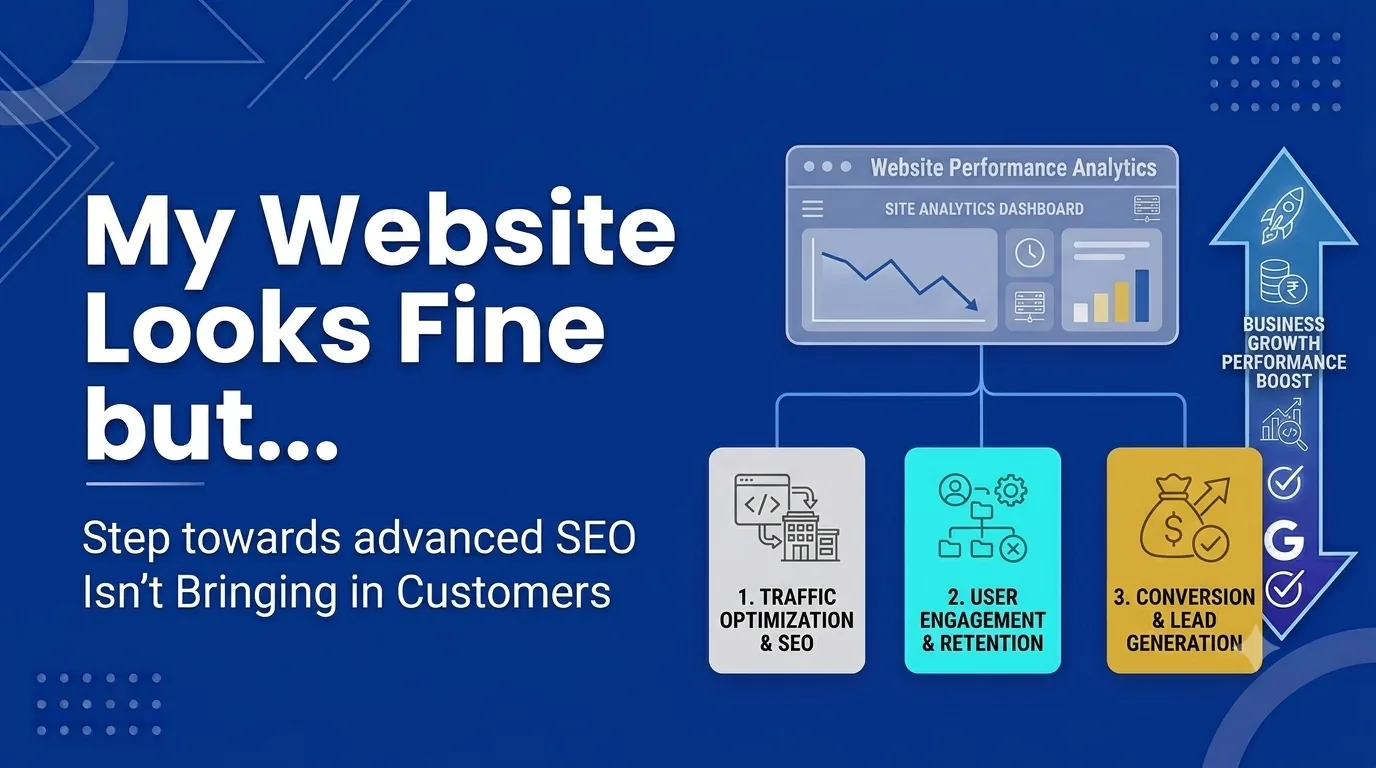
My Website Looks Fine but Isn’t Bringing in Customers
Updated on - 6th September, 2026