BLOG ON
Custom Dealer and Distributor Management Software
PUBLISHED ON - 23rd October, 2026 · 9 min read
PUBLISHED BY

Aditya Prem Sharma
Product Specialist
Custom Dealer and Distributor Management Software
Your company manufactures products worth ₹5 crore every month.
You have 150 dealers, 25 distributors, and sales representatives across multiple states.
Business is growing. Orders are coming in. Your distributors are purchasing more stock.
But here's the question:
Are your products actually selling, or are they just moving from your warehouse into your distributors' warehouses?
Your ERP shows ₹5 crore in sales. Your distributors report healthy demand. But some dealers complain about stock shortages while others have products sitting unsold for weeks.
Your sales team spends hours collecting orders on WhatsApp, confirming prices, and chasing payment updates.
And when your CEO asks which region is performing best, everyone opens a different spreadsheet.
Warning
High primary sales don't always mean strong market demand. If distributors keep buying but retailers aren't selling, your distribution network may be accumulating inventory rather than generating sustainable growth.
This is why manufacturers invest in Dealer and Distributor Management Software (DMS).
A DMS connects manufacturers, distributors, dealers, and field sales teams through a centralized system for ordering, inventory, pricing, payments, and performance reporting.
It helps you answer questions that disconnected spreadsheets and ERP reports often cannot.
And this isn't just an enterprise problem. A manufacturer with 20 distributors can face many of the same operational challenges as a company with thousands.
Your ERP Doesn't Show the Entire Picture
Most manufacturers already have software.
They may use SAP, Microsoft Dynamics, Tally, Zoho, or another ERP to manage purchases, invoices, accounting, and inventory.
But an ERP doesn't automatically provide visibility into everything happening beyond the manufacturer's warehouse.
The difference between primary and secondary sales
Consider a hypothetical month:
| Sales Movement | Amount | What It Means |
|---|---|---|
| Manufacturer to distributors | ₹5 crore | Primary sales |
| Distributors to retailers | ₹3.2 crore | Secondary sales |
| Difference | ₹1.8 crore | Potential channel inventory buildup |
The difference isn't necessarily unsold stock. Returns, opening inventory, timing differences, and other stock movements also affect the calculation.
But the example reveals why primary sales alone are insufficient for evaluating downstream demand.
What manufacturers often cannot see
- Which dealers are ordering consistently
- Which distributors are holding aging stock
- Where popular products are unavailable
- Which regions have unusually high returns
- Which dealer accounts have overdue payments
- Which promotions are producing repeat orders
A manufacturer should be able to see beyond the distributor's purchase order. Otherwise, decisions about production, inventory, and sales incentives may rely on incomplete information.
The real opportunity is to connect the entire distribution journey.
What a Modern DMS Actually Looks Like
A custom DMS isn't just one dashboard.
It's a connected set of tools designed for different people in your distribution network.
One platform, different experiences
Each user sees the information and actions relevant to their responsibilities.
What each participant needs
| User | Most Important Capabilities |
|---|---|
| Manufacturer | Primary/secondary sales, stock visibility, partner performance |
| Distributor | Dealer orders, inventory, dispatch, invoices, collections |
| Dealer | Catalogue, prices, schemes, ordering, delivery status |
| Sales representative | Assigned accounts, field orders, visits, targets |
| Finance team | Credit limits, receivables, claims, reconciliation |
Example: A dealer places an order
Instead of calling a sales representative, a dealer opens the portal.
They see their eligible products, agreed pricing, available promotions, and previous orders.
They select quantities and submit the request.
The assigned distributor receives the order, verifies stock and credit conditions, and begins fulfillment.
Head office can monitor the order without asking the distributor for another spreadsheet.
That's the value of a connected workflow: fewer manual handoffs and better visibility for everyone.
Real Case Study: HUL's Shikhar Platform
One of India's strongest examples of digital distribution is Hindustan Unilever Limited (HUL).
HUL operates an extensive distribution network serving retailers across India.
Its Shikhar platform, launched in 2019, provides a digital ordering experience for retailers while working within HUL's distributor-inclusive model.
The business challenge
Retailers traditionally depended heavily on sales representatives for ordering.
This meant that routine purchases often required scheduled visits or direct communication.
For a large distribution network, those interactions create substantial operational complexity.
What Shikhar introduced
Shikhar gives retailers access to:
- Digital product ordering
- Product discovery and recommendations
- Transparent pricing
- Promotional offers
- Repeat-order assistance
- Credit-related services
- Ordering outside normal sales visit schedules
Published business figures
| HUL Distribution Metric | Reported Figure |
|---|---|
| Retailers onboarded on Shikhar | 1.4 million+ |
| Shikhar monthly active user rate | 70% |
| Distributors in HUL's network | 3,500+ |
| Retail outlets reached | 9 million+ |
HUL also reported that 35% of demand was captured digitally across its relevant digital channels in FY2024–25. That is a broader figure, not a Shikhar-only metric.
What this means for your business
The lesson isn't that every manufacturer needs an application with millions of users.
It's that digital ordering must create value for the dealer, not just improve reporting for the manufacturer.
A dealer is more likely to use a portal when it makes ordering easier, provides accurate prices, and reduces unnecessary follow-ups.
Tip
Design your dealer portal around the dealer's daily problems first. Better adoption creates more useful data for the manufacturer.
Where a DMS Can Improve Revenue and Cash Flow
A DMS can affect several business outcomes, but those improvements must be measured.
Faster dealer ordering
Digital catalogues, repeat orders, and automated price calculations reduce manual work.
Better product availability
Distributor inventory visibility helps identify stock shortages and excess inventory.
More effective promotions
Manufacturers can apply scheme rules consistently and analyze participation.
Improved collections visibility
Credit limits, invoices, and outstanding balances can be made visible to authorized teams.
Better territory performance
Sales managers can compare distributor and dealer activity using consistent metrics.
Example: The cost of manual order entry
Consider a manufacturer processing 6,000 dealer orders every month.
Assume each order requires four minutes of manual entry and checking.
If digital ordering reduces average handling time to one minute, the business releases approximately 300 employee hours each month.
At an assumed labor cost of ₹300 per hour, that represents ₹90,000 in monthly labor capacity.
This is an illustrative calculation, not a measured customer result or guaranteed payroll saving.
The more important opportunity may be that employees can spend less time entering orders and more time supporting dealers, resolving problems, and developing sales.
Metrics worth monitoring
| KPI | Why It Matters |
|---|---|
| Digital order adoption | Measures dealer usage |
| Order processing time | Shows administrative efficiency |
| Secondary sales | Indicates downstream sales activity |
| Inventory aging | Highlights slow-moving products |
| Order fulfillment rate | Measures delivery performance |
| Days sales outstanding | Tracks collection efficiency |
| Active dealers | Shows partner engagement |
| Repeat-order frequency | Indicates ongoing purchasing activity |
The value of a DMS should be demonstrated through these outcomes, not the number of features installed.
Which DMS Features Should You Build First?
A common mistake is attempting to build every possible feature before launching.
A better approach is to prioritize the problems creating the greatest operational cost.
Start with ordering and visibility
For many manufacturers, the first release should focus on:
Dealer ordering portal
Allow dealers to browse products, view applicable prices, and place orders.
Distributor dashboard
Give distributors a structured way to manage incoming orders and fulfillment.
Product and pricing management
Maintain consistent catalogues, partner pricing, and applicable promotions.
Order tracking
Let dealers and sales teams see order status without constant calls.
Basic sales reporting
Provide head office with consistent ordering and sales information.
Add financial and operational depth
Once the core process works, consider:
- Distributor inventory synchronization
- Credit and outstanding management
- Returns and claims
- Secondary sales reporting
- Sales representative applications
- Territory and performance analytics
Introduce advanced capabilities selectively
Larger networks may benefit from demand forecasting, route planning, intelligent replenishment, or recommendation systems.
But those features depend on reliable operational data.
Important
Don't build AI demand forecasting before you can trust your inventory and secondary sales data. Accurate information is more valuable than sophisticated predictions based on inconsistent records.
The right feature roadmap depends on how your distribution network actually operates.
DMS vs ERP vs CRM: What Do You Need?
A DMS doesn't necessarily replace your existing business software.
It often works alongside it.
How the systems differ
| Capability | ERP | DMS | CRM |
|---|---|---|---|
| Financial accounting | Core | Integrated | Limited |
| Manufacturing operations | Core | Not typical | Not typical |
| Dealer ordering | Product-dependent | Core | Product-dependent |
| Distributor inventory | Product-dependent | Core | Limited |
| Secondary sales reporting | May need customization | Core | Limited |
| Sales opportunity tracking | Varies | Limited | Core |
| Partner schemes | May need customization | Common | Limited |
| Credit visibility | Often supported | Integrated | Limited |
A practical integration strategy
Your ERP can remain the authoritative system for product records, accounting, invoices, and inventory transactions.
Your DMS can manage dealer-facing ordering and distributor workflows.
Your CRM can continue managing customer relationships and sales opportunities where appropriate.
The systems exchange information through supported APIs or other integration methods.
What needs careful planning?
Data ownership: Which system controls prices, stock, and financial records?
Synchronization: How frequently should information move between systems?
Error handling: What happens if an order reaches the DMS but fails in the ERP?
Access control: Which dealers and distributors can see particular information?
Reconciliation: How do you detect missing or conflicting transactions?
A poorly planned integration can create duplicate records and inconsistent information.
A well-planned one can preserve your existing investments while improving distribution operations.
Custom DMS Development Cost in India
A custom DMS can range from a simple ordering portal to a comprehensive distribution platform.
The following are illustrative 2026 planning budgets for Indian software development, not verified market averages or fixed quotations.
| Project Scope | Indicative Development Budget |
|---|---|
| Basic dealer ordering portal | ₹4–8 lakh |
| Dealer and distributor portals | ₹8–15 lakh |
| DMS with ERP and inventory integration | ₹15–30 lakh |
| Advanced DMS with field sales and analytics | ₹30–60 lakh |
| Enterprise distribution platform | ₹60 lakh–₹1.5 crore+ |
What makes a DMS expensive?
Pricing complexity: Different dealer rates, territories, schemes, and discount rules.
ERP integrations: Connecting legacy systems or complex enterprise applications.
Inventory management: Supporting multiple warehouses and distributors.
Financial workflows: Credit controls, claims, returns, and payment reconciliation.
Mobile and offline support: Allowing field teams to work in areas with poor connectivity.
Reporting requirements: Consolidating primary sales, secondary sales, inventory, and collections.
Don't ignore ongoing costs
Development isn't the only expense.
You should also plan for:
- Cloud hosting and databases
- Maintenance and security updates
- ERP integration monitoring
- Backup and recovery
- User support and onboarding
- New features and improvements
A lower initial development quote isn't necessarily cheaper if the platform becomes difficult to maintain.
How to Launch Without Disrupting Your Network
Rolling out a DMS affects more than the IT department.
It changes how dealers place orders, how distributors fulfill them, and how sales representatives work.
A phased rollout reduces operational risk.
Phase 1: Understand the current process
Document how orders, pricing, inventory updates, and collections work today.
Identify manual steps and recurring errors.
Phase 2: Choose a pilot territory
Start with a limited group of distributors and dealers.
Select participants who represent real operational conditions, not only your easiest accounts.
Phase 3: Launch digital ordering
Introduce catalogues, dealer-specific pricing, order placement, and tracking.
Keep existing fallback processes available during the transition.
Phase 4: Validate integrations
Confirm that orders, invoices, inventory, and financial information remain consistent across connected systems.
Phase 5: Measure adoption and performance
Track active dealers, digital orders, fulfillment time, and support issues.
Phase 6: Expand gradually
Roll out to additional territories once the initial workflow is stable.
Before expanding, check these signals
- Included: Dealers can place orders without assistance.
- Included: Distributor teams can process orders reliably.
- Included: Prices and schemes match approved business rules.
- Included: ERP synchronization errors are monitored.
- Included: Order status is accurate.
- Included: Users know how to get support.
- Included: Management can measure adoption and performance.
A DMS rollout succeeds when dealers and distributors find it easier to work with your business than before.
Technology adoption is a business change, not merely a software deployment.
Build Your Distribution Platform with SSP
Every distribution network has its own operating model.
Some manufacturers sell through regional distributors. Others serve dealers directly. Some require complex territory pricing, credit policies, and promotional schemes.
A ready-made DMS may work when your requirements fit its standard workflows.
But when your business needs specialized integrations, partner experiences, or operational controls, custom software can be worth evaluating.
At Software Studio Pro, we develop custom business software, web applications, enterprise portals, APIs, and integration solutions.
How we can help
Custom dealer ordering portals
Build branded portals with product catalogues, partner-specific pricing, order placement, and tracking.
Distributor management dashboards
Manage incoming orders, inventory visibility, dispatch workflows, returns, and operational reporting.
ERP and accounting integrations
Connect the DMS with your existing business systems using supported interfaces.
Field sales applications
Help sales representatives manage assigned accounts, capture orders, and record field activities.
Credit and collections dashboards
Provide authorized teams with visibility into invoices, outstanding amounts, and credit limits.
Sales and inventory analytics
Track distributor performance, dealer activity, primary and secondary sales, and inventory movement.
Ongoing development and maintenance
Support the platform as your distribution network expands and requirements evolve.
Where should your business start?
We recommend beginning with the three problems that create the most friction.
For example:
- Dealers cannot place orders without calling sales representatives.
- Distributors submit inventory information manually.
- Management cannot reliably track secondary sales.
A focused initial release can address those problems before expanding into more complex capabilities.
Your first DMS doesn't need every feature. It needs to make ordering, fulfillment, and visibility meaningfully better.
If your distribution network depends on WhatsApp orders, disconnected spreadsheets, and manual follow-ups, we can help assess the workflow and plan a custom solution.
FAQ
What is a Dealer and Distributor Management System?
A DMS is software that helps manufacturers manage dealer orders, distributor operations, inventory visibility, pricing, collections, and sales performance.
What is the difference between primary and secondary sales?
Primary sales are sales from manufacturers to distributors. Secondary sales are sales from distributors to dealers or retailers.
Can a DMS integrate with SAP or Tally?
Yes, depending on the available interfaces, software versions, and integration requirements.
Does a DMS replace an ERP?
Not necessarily. A DMS often works alongside an ERP, which continues managing accounting, procurement, inventory, and other core processes.
Can dealers place orders through mobile devices?
Yes. A DMS can provide responsive web portals, mobile applications, or both.
Can a DMS manage different dealer prices?
Yes. A custom system can support partner-specific pricing, territories, discount rules, and promotional schemes.
How much does custom DMS development cost?
A focused dealer ordering portal in India might be budgeted around ₹4–8 lakh. Larger systems with ERP integrations and advanced workflows may require ₹15–60 lakh or more. These are illustrative estimates.
How long does DMS development take?
A focused portal may take approximately two to four months. More comprehensive platforms may require four to eight months or longer.
Can a DMS work offline?
Some mobile applications can support offline data capture and later synchronization, but this requires careful handling of conflicts and duplicate submissions.
How can manufacturers improve dealer adoption?
Make ordering easier, show accurate prices, provide reliable order tracking, train users, and introduce the platform gradually.
Is custom DMS better than ready-made software?
It depends on the business. Ready-made tools may suit standard workflows, while custom development is useful for specialized pricing, integrations, and distribution processes.
Ready to bring your business idea to life? Contact us today and let's build something amazing together!
Contact Us
READ MORE BLOGS
Enterprise Customer Self-Service Portal Development
Published on - 23rd October, 2026
Real-Time Fleet and Logistics Control Tower Development
Published on - 23rd October, 2026
Enterprise Workflow Automation Across ERP and CRM
Published on - 23rd October, 2026
Building AI Agents That Work Inside Enterprise Software
Published on - 23rd October, 2026
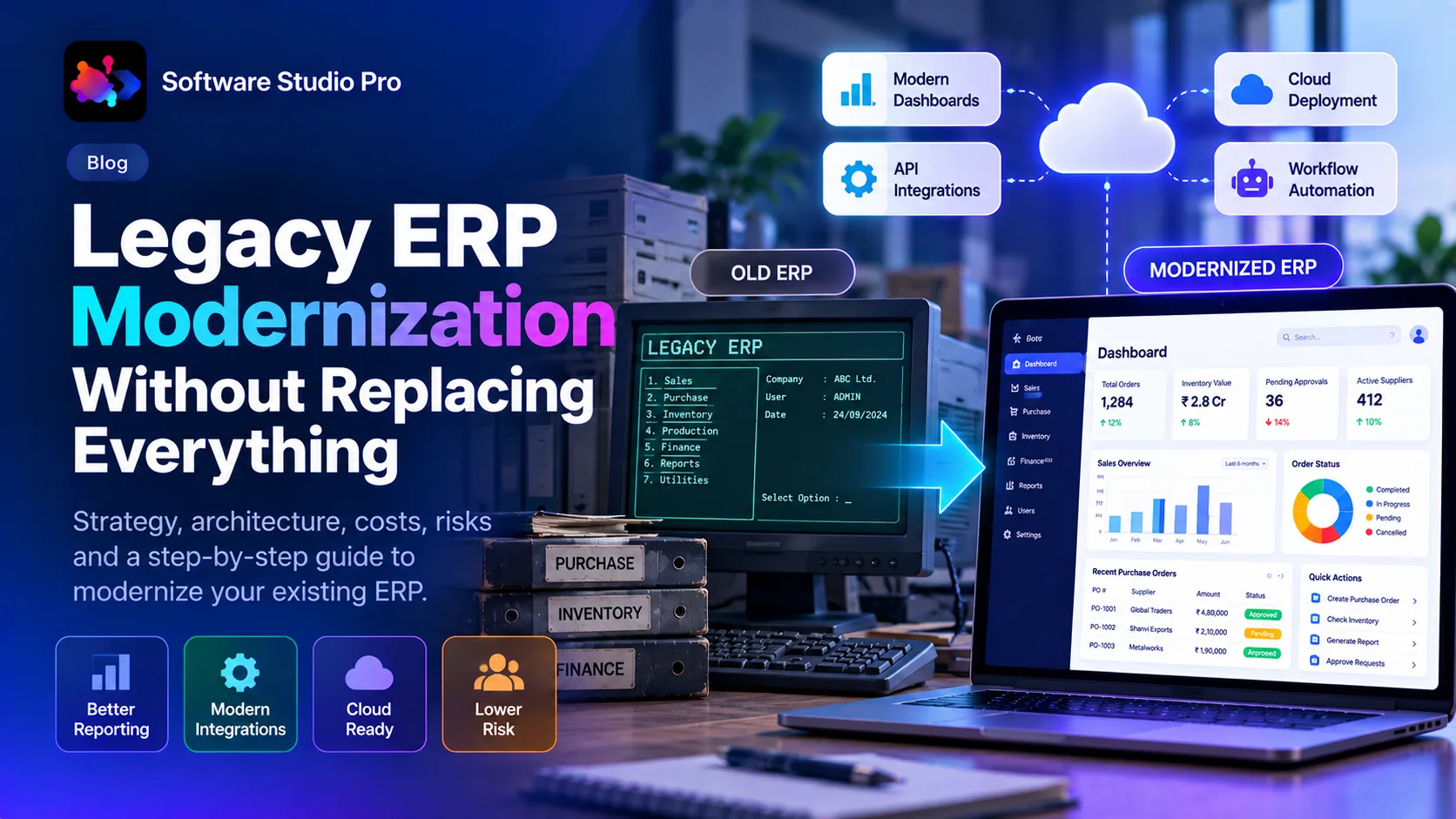
Legacy ERP Modernization Without Replacing Everything
Published on - 23rd October, 2026