BLOG ON
Custom Gym Management Software: Features, Cost & ROI
PUBLISHED ON - 28th October, 2026 · 7 min read
PUBLISHED BY

Aditya Prem Sharma
Product Specialist
Your Gym May Be Losing Revenue You Already Earned
Imagine running a gym with 600 active members.
New people join every month. Your trainers are busy, and your front desk handles enquiries throughout the day.
Yet monthly revenue is unpredictable.
Some members forget to renew. Others stop attending without anyone noticing. Personal training sessions get booked through WhatsApp, and the owner cannot easily tell which marketing campaigns generate paying members.
The gym doesn't necessarily need more leads.
It may need a better system for managing the members it already has.
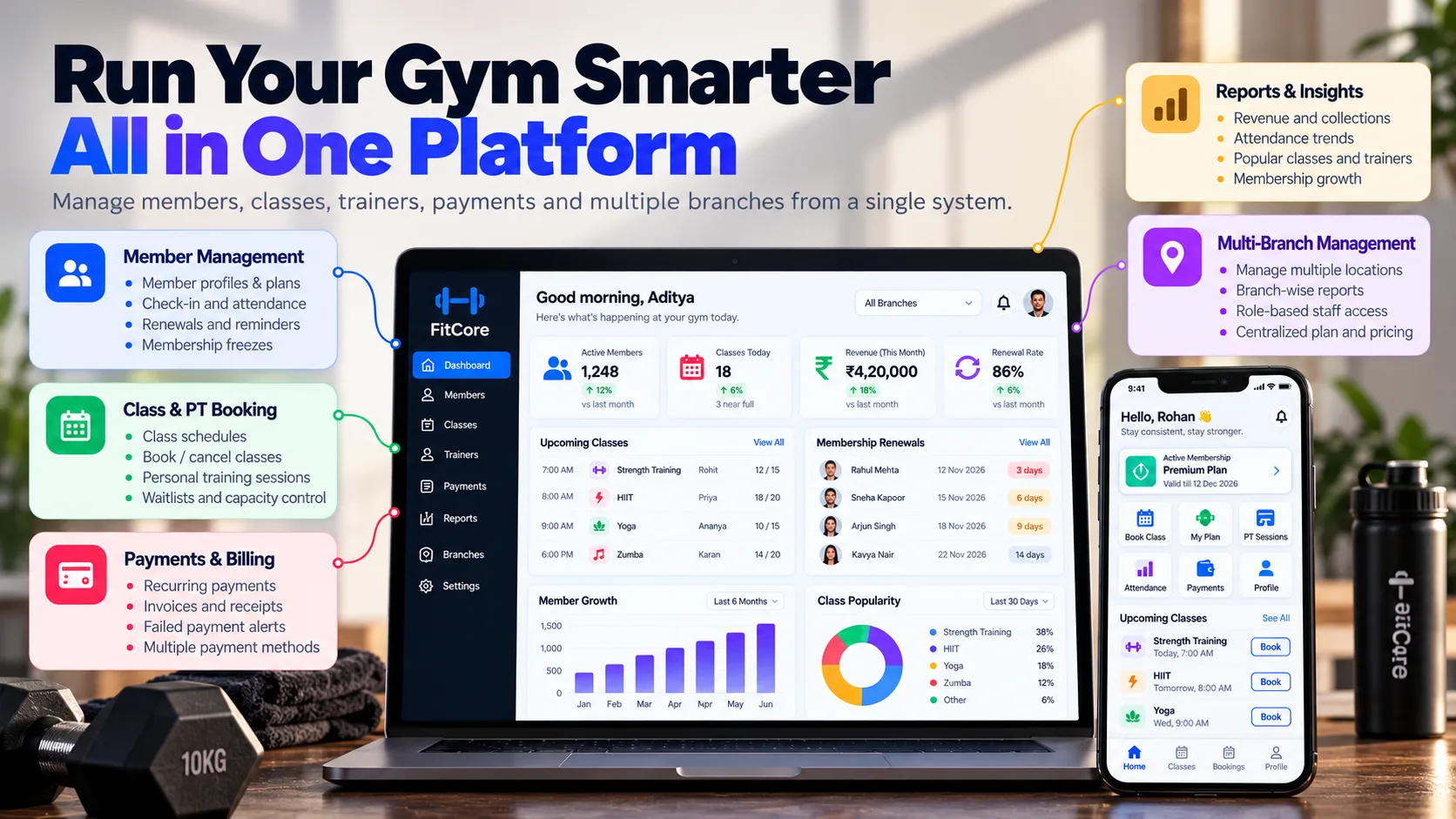
Custom gym management software brings memberships, renewals, attendance, class scheduling, payments, trainers, and customer relationships into one platform.
But building custom software is an investment. The first question should not be which features look impressive.
It should be:
Where is your gym losing money, time, or member loyalty today?
A profitable gym doesn't just attract members. It makes joining, attending, renewing, and staying remarkably easy.
Find the Revenue Leaks Before Building Software
Most gym management problems fall into four categories.
| Revenue Leak | What Happens | Software Opportunity |
|---|---|---|
| Missed renewals | Members expire without timely follow-up | Renewal reminders and payment tracking |
| Low attendance | Members gradually stop visiting | Attendance trends and engagement alerts |
| Lost enquiries | Trial visitors never receive follow-ups | Lead CRM and sales pipeline |
| Underused services | PT slots and classes remain empty | Scheduling and booking management |
The important distinction is that these problems need different solutions.
A renewal problem doesn't automatically require an AI recommendation engine.
A class-booking problem doesn't require rebuilding the entire gym's accounting system.
Start with the loss you can actually measure.
A simple membership leakage example
Suppose 100 memberships are due for renewal this month.
Your gym renews 70.
The other 30 expire.
If each membership costs ₹2,000 per month, those 30 members represent ₹60,000 in potential monthly recurring revenue.
Now imagine a structured follow-up process helps retain five additional members.
5 × ₹2,000 = ₹10,000 in additional monthly recurring revenue.
If those five members remain active for another six months, that's ₹60,000 in revenue before costs and any subsequent changes.
This is a hypothetical illustration, not a guaranteed improvement.
Important
Renewal reminders can improve follow-up consistency, but they cannot replace good coaching, clean facilities, appropriate pricing, and a positive member experience.
Design the Member Journey, Not Just the Dashboard
A gym member experiences your business as a sequence of interactions.
Your software should make those interactions feel connected.
Before joining
A prospective member discovers your gym, submits an enquiry, books a trial, and speaks with your sales team.
The system should track the enquiry source, trial booking, assigned salesperson, and follow-up outcome.
On joining
The member chooses a plan, accepts the membership terms, pays, and receives access.
The system should record the membership period, payment status, applicable policies, and access permissions.
During membership
The member checks in, books classes, attends training sessions, and receives relevant updates.
Before renewal
The system identifies the upcoming expiry and supports an appropriate renewal process.
After inactivity
Staff can review attendance patterns and decide whether a helpful personal check-in is appropriate.
A unified member record prevents your reception, trainers, and management from working with conflicting information.
What Would Members Actually Use?
Not every gym needs a feature-heavy mobile application.
Members generally care about completing a few tasks quickly.
Can I see whether my membership is active?
Can I book my preferred class?
Can I check my remaining personal training sessions?
Can I renew without contacting reception?
Those questions provide a better starting point than copying features from a fitness social network.
Member-facing features
- Membership status and renewal
- Class and personal training booking
- Booking cancellations and waitlists
- Payment receipts and invoices
- Attendance history
- Announcements and schedule changes
- Optional workout or progress tracking
Staff-facing features
- New member registration
- Lead and trial management
- Membership plans and freezes
- Payment tracking
- Trainer schedules
- Check-in and attendance
- Follow-up tasks
- Revenue and retention reports
A feature worth getting right: membership freezes
A member may temporarily pause a membership because of travel or another reason permitted by the gym's policy.
Your system should clearly define how that affects expiry dates, billing, access, and any applicable limits.
A poorly implemented pause feature can create disputes and inconsistent financial records.
The Business Case: A Real Gym's Results
LivingWell Health Club in Kilmainham, Ireland, provides a useful example of the operational impact of gym management software.
According to a published ClubWise case study, LivingWell previously spent time manually managing direct debit files, failed payments, renewal reminders, and disconnected class scheduling.
After adopting ClubWise, the business reported:
| Reported Result | Outcome |
|---|---|
| Membership base | Grew from 790 to 1,006 |
| Direct debit revenue | Over 30% above its previous highest month |
| Administrative workflow | Less manual payment-file and failure handling |
These are outcomes reported by the software vendor and customer. They do not establish that the software alone caused every improvement or that another gym will achieve similar results.
The lesson for gym owners
LivingWell's example highlights a useful principle:
Reliable billing and membership administration can be commercially important even without complicated new features.
A custom platform should first solve the operational problems that affect your revenue and customer experience.
One Gym, Three Gyms, or Thirty?
The right architecture changes as a fitness business expands.
A single-location gym may only need membership management, payments, attendance, and basic reporting.
A multi-branch chain needs additional controls.
| Requirement | Single Gym | Multi-Branch Chain |
|---|---|---|
| Membership database | One location | Shared or branch-specific |
| Trainer scheduling | Local | Across locations |
| Member access | Single facility | Based on membership privileges |
| Pricing | Simple plans | Branch and region variations |
| Reporting | Gym-level | Branch comparisons and consolidated totals |
| Staff permissions | Basic roles | Branch-level and corporate roles |
| Promotions | Local offers | Central campaigns with local exceptions |
Example: a member visits another branch
Suppose a member belongs to Branch A but wants to attend a class at Branch B.
The system must determine whether their membership allows cross-branch access, whether the class has capacity, and which branch receives credit for the booking.
These rules should be explicit.
Without them, multi-branch reporting and access control can become inconsistent.
What franchise owners need
Franchise businesses may also require centralized plan definitions, brand-wide reporting, location-specific pricing, and controls over which settings each franchise can modify.
That's where a custom platform can offer value beyond a basic membership database.
Buy Existing Software or Build Your Own?
Before commissioning custom development, evaluate established gym management products.
Platforms such as ABC Glofox, Mindbody, Gymdesk, and others offer combinations of memberships, bookings, billing, check-ins, communications, and reporting.
For example, ABC Glofox documents capabilities for recurring billing, class waitlists, access control, branded member apps, and multi-location operations.
Source: ABC Glofox Gym Management Features.
When ready-made software makes sense
Choose an existing platform when your gym follows common membership and booking processes, the pricing is affordable, and the available integrations meet your needs.
When custom development makes sense
Consider building when your business needs:
- Unusual membership and package rules
- Deep integration with existing hardware or systems
- Complex franchise or branch permissions
- A differentiated branded member experience
- Specialized personal training or wellness workflows
- Greater control over reporting and customer data
- Integration with an existing CRM, ERP, or financial platform
A hybrid approach can also work.
For example, retain an established payment provider while developing your own member portal, booking workflows, and administrative platform.
Tip
Before buying or building, test five real situations: a new signup, a failed renewal, a membership freeze, a class cancellation, and a member changing branches. These reveal more than a polished product demo.
What Does Custom Gym Software Cost in 2026?
The development budget depends on whether you're building a simple internal system, a customer-facing mobile application, or a platform for multiple locations.
Illustrative development costs in India
| Software Scope | Estimated Budget |
|---|---|
| Membership and payment management | ₹3–7 lakh |
| Gym CRM with classes and trainer scheduling | ₹7–15 lakh |
| Branded member app with admin platform | ₹12–25 lakh |
| Multi-branch or franchise management system | ₹25–50 lakh+ |
These are illustrative 2026 planning estimates, not independently verified market averages or binding quotations.
Additional costs may include payment processing, messaging, hosting, maintenance, hardware integration, and ongoing support.
A simple ROI scenario
Suppose a gym saves 50 hours of administration per month through automated registration, payment reconciliation, and renewal follow-ups.
At an illustrative staff cost of ₹300 per hour, that represents ₹15,000 of monthly capacity.
If the same system also helps retain five additional members paying ₹2,000 monthly, the additional recurring revenue is ₹10,000 per month.
Combined, the modeled monthly benefit is ₹25,000, or ₹3 lakh annually.
However, saved staff capacity is not automatically cash savings, and additional membership revenue is not profit.
A proper investment decision should account for development, operating costs, support, and actual measured results.
A Better Rollout Than Building Everything at Once
Instead of launching a large system with dozens of modules, organize development around measurable business outcomes.
Release 1: Stop operational leakage
Build member records, plan management, renewals, payment status, and staff access.
Success measure: fewer untracked expiries and less manual administration.
Release 2: Improve attendance and bookings
Introduce class scheduling, trainer appointments, attendance tracking, and cancellation rules.
Success measure: improved booking utilization and reliable attendance records.
Release 3: Strengthen member relationships
Add member self-service, communications, feedback, and useful engagement reporting.
Success measure: better member experience and clearer retention signals.
Release 4: Support expansion
Add branch-level permissions, consolidated reporting, and franchise workflows where required.
Success measure: consistent operations across locations without unnecessary administrative duplication.
Don't automate poor processes
If your membership policies are inconsistent, software will make those inconsistencies harder to manage.
Define pricing, freeze policies, cancellations, refunds, and access rules before implementation.
Your Gym's Next Competitive Advantage
Gym management software should make three things easier:
Running the business. Staff spend less time chasing information.
Serving members. Customers can book, pay, and manage their memberships with less friction.
Making decisions. Owners can understand revenue, attendance, renewals, and branch performance.
The most valuable software is not necessarily the platform with the longest feature list.
It's the one that addresses the operational problems your business actually has.
How Software Studio Pro Can Help
Software Studio Pro develops custom web applications, mobile apps, management platforms, CRM systems, and third-party integrations.
For gyms and fitness businesses, that can include membership platforms, class booking applications, trainer scheduling, payment integrations, branded member portals, and multi-branch dashboards.
We can help you decide whether a focused custom module or a complete platform is the better investment.
Build a better gym business, not just another gym dashboard.
FAQ
What is custom gym management software?
Custom gym management software is an application built around a fitness business's specific needs for memberships, payments, class bookings, trainers, attendance, and operations.
How much does gym management software development cost?
Illustrative custom development budgets in India may start around ₹3–7 lakh for a focused membership system. Multi-branch platforms and branded mobile applications can cost considerably more.
Can gym software automate membership renewals?
Yes. It can track expiry dates, send authorized reminders, manage supported recurring payments, and help staff follow up on unpaid memberships.
Can members book classes through an app?
Yes. A member portal or mobile app can support schedules, available slots, bookings, cancellations, waitlists, and notifications.
Does a small gym need custom software?
Not necessarily. Small gyms should compare established software before investing in custom development. Customization becomes more valuable when standard tools cannot support important business processes.
Can gym management software support multiple branches?
Yes. A custom platform can support branch-specific memberships, trainer schedules, access rules, permissions, and consolidated reporting.
Can gym software track inactive members?
Yes. Attendance records can help identify members whose visits have declined, allowing staff to offer appropriate follow-up and support.
How long does custom gym software take to develop?
A focused membership and administration platform may take a few months. Mobile applications, payment integrations, hardware connectivity, and multi-branch features can extend the timeline.
Ready to bring your business idea to life? Contact us today and let's build something amazing together!
Contact Us
READ MORE BLOGS

Custom Production Planning Software Development Guide
Published on - 28th October, 2026
Custom Subscription Billing Software Development Guide
Published on - 28th October, 2026

Custom Travel Agency Booking Software Development Guide
Published on - 28th October, 2026
Custom Legal Case Management Software: A Practical Guide
Published on - 28th October, 2026

Custom Quality Management Software Development Guide
Published on - 28th October, 2026