BLOG ON
Custom Fleet Maintenance Software Development Guide
PUBLISHED ON - 28th October, 2026 · 7 min read
PUBLISHED BY

Aditya Prem Sharma
Product Specialist
One Breakdown. Three Deliveries Delayed.
It's 6:40 AM. A delivery truck is scheduled to leave the warehouse.
The driver reports an engine warning. The dispatcher checks the maintenance spreadsheet and discovers that the vehicle's last scheduled service is overdue.
The workshop has no available technician. A replacement truck is already assigned to another route.
Now three deliveries are at risk.
The repair bill is only one part of the problem. The business also faces delayed orders, additional coordination, potential overtime, and dissatisfied customers.
Custom fleet maintenance software helps transport businesses prevent avoidable breakdowns by connecting vehicle inspections, service schedules, repair histories, work orders, spare parts, and maintenance costs.
It gives fleet managers a clearer answer to a critical question:
Which vehicles are safe, available, and ready for tomorrow's work?
The most expensive repair is often the one that happens when a vehicle should be earning revenue.
The objective isn't to eliminate every breakdown. It's to replace avoidable surprises with planned, accountable maintenance.
Is Your Fleet Reactive or Preventive?
Fleet maintenance generally falls into three approaches.
| Approach | How It Works | Example |
|---|---|---|
| Reactive | Repair after a fault occurs | Replace a failed alternator |
| Preventive | Service at defined intervals | Inspect brakes every scheduled interval |
| Condition-based | Act on observed equipment condition | Investigate recurring engine fault codes |
Predictive maintenance uses historical and live data to estimate potential failures. It may be useful for larger fleets, but it requires reliable data and careful validation.
For most businesses, preventive maintenance is the sensible starting point.
The US Federal Motor Carrier Safety Administration (FMCSA) explains that systematic maintenance means following a regular or scheduled program to keep vehicles in safe operating condition. It also notes that appropriate maintenance intervals depend on the fleet and sometimes on individual vehicles.
Why spreadsheets become difficult
A spreadsheet may tell you when a truck was last serviced.
It usually won't automatically connect that record to a driver's defect report, a workshop booking, spare-part availability, and the dispatch schedule.
As the fleet grows, maintenance becomes a coordination problem.
Tip
Before considering predictive AI, make sure every vehicle has an accurate service history, maintenance schedule, and reliable process for reporting defects.
A Vehicle's Maintenance History Should Tell a Story
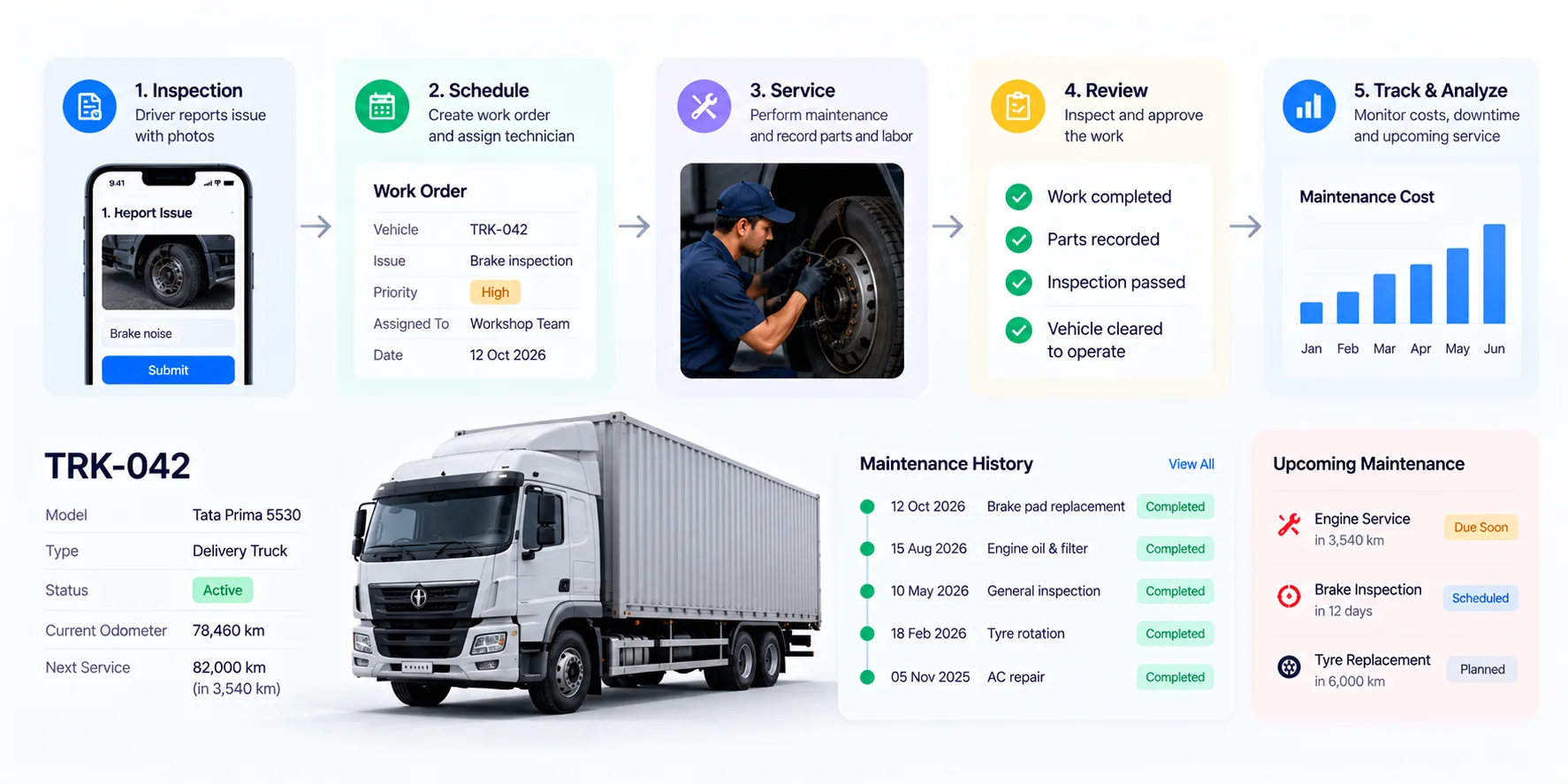
Consider vehicle TRK-042, a commercial delivery truck.
Its digital record could contain:
Now imagine the vehicle develops a recurring brake problem.
The maintenance manager can examine previous repairs, inspection findings, replacement parts, technician notes, and mileage between incidents.
Instead of repeatedly treating the symptom, the team has the information needed to investigate the underlying cause.
What should every vehicle record include?
- Vehicle identification and ownership details
- Mileage or operating hours
- Scheduled maintenance activities
- Inspection and defect reports
- Repair work orders
- Parts and labor costs
- Warranty information
- Maintenance-related documents
- Vehicle availability status
The system should also distinguish reported defects, repairs completed, and vehicles formally cleared for operation.
Those are different events and should not be represented by one generic “Completed” status.
Design Around the Maintenance Decision
The best fleet software isn't necessarily the one with the most modules.
It's the one that helps employees make the right decision at the right time.
The driver reports a defect
A mobile inspection form lets the driver identify a vehicle, report an issue, attach photographs, and submit relevant details.
The system records the submission time and notifies the responsible team.
The supervisor evaluates the risk
A maintenance supervisor reviews the issue and decides whether the vehicle requires immediate removal from service, further inspection, or a scheduled repair.
Safety-critical decisions should follow the organization's procedures and applicable regulations.
The workshop receives a work order
The repair team sees the vehicle history, fault description, assigned technician, required parts, and planned completion date.
The dispatcher sees availability
A vehicle under maintenance should not silently appear available for assignment.
Where integrated with dispatch software, maintenance status can inform vehicle allocation.
The repair is verified
After work is completed, authorized personnel record the inspection or release decision.
Warning
A software status change is not a substitute for a physical safety inspection. Unsafe vehicles must remain out of operation until appropriate repairs and checks have been completed.
The Feature Priority Matrix
Not every fleet needs GPS tracking, AI predictions, or a complicated telematics platform.
A maintenance-focused MVP should prioritize reliable records and operational coordination.
| Feature | Priority | Why It Matters |
|---|---|---|
| Vehicle registry | Essential | Establishes reliable asset records |
| Maintenance schedules | Essential | Identifies upcoming service |
| Driver defect reporting | Essential | Captures problems early |
| Repair work orders | Essential | Assigns and tracks maintenance |
| Vehicle availability | Essential | Prevents scheduling conflicts |
| Parts and inventory | High | Reduces repair delays |
| Vendor management | High | Tracks outsourced maintenance |
| Cost reporting | High | Identifies expensive vehicles |
| Telematics integration | Conditional | Adds mileage and fault data |
| Predictive maintenance | Later | Requires sufficient quality data |
A useful distinction: GPS vs maintenance
GPS and fleet tracking systems primarily help businesses understand vehicle location and movement.
Fleet maintenance systems focus on vehicle condition, servicing, repairs, and availability.
A business may need both, but it doesn't necessarily need to rebuild both.
Integrating an existing GPS or telematics provider with a custom maintenance platform can be more practical.
What Real Fleet Operators Have Achieved
A useful example comes from A#1 Air, a US home-services business that used Geotab's fleet technology to monitor vehicle health.
According to Geotab's published case study, the company introduced automated oil-change reminders and engine-fault notifications.
The case study describes two instances in which engine alerts prompted early workshop visits, helping the company avoid potentially more serious repairs.
Geotab also reports that missed service visits could cost the business between $500 and $2,500 per breakdown.
This is a vendor-published case study, and the figures reflect that particular company's circumstances.
The important lesson is not that every fleet will achieve the same savings.
It's that maintenance alerts become valuable when someone can act on them before a vehicle fails.
A custom system can support the same operational principle by connecting alerts to inspection decisions, work orders, and vehicle availability.
Find the Real Cost of Vehicle Downtime
Maintenance software should be evaluated against measurable operational problems.
Imagine a transport company operating 60 commercial vehicles.
It experiences an average of eight unplanned breakdowns per month.
Assume each breakdown creates ₹12,000 in combined repair-related disruption, emergency coordination, and operational losses beyond routine planned servicing.
<escape></escape>
| Metric | Illustrative Value |
|---|---|
| Fleet size | 60 vehicles |
| Unplanned breakdowns per month | 8 |
| Average disruption cost per breakdown | ₹12,000 |
| Estimated monthly disruption cost | ₹96,000 |
| Estimated annual disruption cost | ₹11.52 lakh |
If better preventive maintenance reduced avoidable breakdowns by 25%, the equivalent reduction in this modeled disruption cost would be:
₹11.52 lakh × 25% = ₹2.88 lakh annually.
This is a hypothetical business case, not a measured outcome or guaranteed saving.
It excludes software costs and assumes the average disruption cost remains constant.
Track these metrics after launch
- Unplanned breakdowns per 100 vehicles
- Maintenance cost per kilometer
- Planned vs unplanned maintenance
- Vehicle availability percentage
- Average repair turnaround time
- Overdue preventive maintenance tasks
- Repeat repairs for the same fault
These metrics make it possible to assess whether software is actually improving operations.
Compliance and Data Accuracy Matter
Commercial fleet maintenance can involve legal inspection and recordkeeping obligations.
In the United States, FMCSA rules under 49 CFR Part 396 require covered motor carriers to maintain inspection, repair, and maintenance records.
The required records include vehicle identification, maintenance schedules, and completed maintenance activities.
FMCSA also permits computerized recordkeeping when the required information is captured and can be reproduced on demand.
Sources: FMCSA Maintenance Records and FMCSA Electronic Records Guidance.
Requirements differ by vehicle category and jurisdiction. Operators in India, the UK, the Middle East, or elsewhere need to apply their own relevant rules.
Build reliable controls into the system
Audit history: Record important changes to maintenance and inspection information.
Role-based permissions: Restrict who can approve repairs or release vehicles.
Document retention: Preserve relevant records according to applicable requirements.
Offline support: Allow drivers to capture inspections where connectivity is unreliable, with safe synchronization when service returns.
Data validation: Prevent invalid mileage, duplicate work orders, and incomplete critical records where appropriate.
For businesses with multiple depots, the system should also support consistent maintenance policies without losing location-specific operational flexibility.
Custom Development: Cost and Architecture
A custom fleet maintenance platform can be developed as a web-based management application with a mobile interface for drivers and technicians.
The architecture might include a vehicle registry, scheduling engine, work-order service, document storage, notifications, and integrations with accounting, dispatch, or telematics systems.
A modular backend is often sufficient initially. Complex microservices are not automatically necessary.
Illustrative development costs in India
| Project Scope | Estimated Budget |
|---|---|
| Vehicle records and service reminders | ₹4–8 lakh |
| Maintenance scheduling and work orders | ₹8–16 lakh |
| Multi-depot system with mobile apps | ₹16–30 lakh |
| Enterprise platform with integrations | ₹30–70 lakh+ |
These are illustrative 2026 planning ranges, not verified market averages or fixed quotations.
The final budget depends on workflow complexity, fleet size, integrations, offline requirements, reporting, and security needs.
When should you build custom software?
Custom development may make sense when you operate multiple depots, use specialized vehicles, have unusual maintenance approval workflows, or need tight integration with existing dispatch and accounting systems.
Ready-made products may be more economical when your processes are standard and an existing platform already meets your requirements.
Compare both options using total ownership cost, implementation effort, support, and integration requirements.
Build the First Release Around One Depot
A fleet-wide rollout is not the best starting point for every business.
A pilot at one depot allows the team to test maintenance processes without disrupting the entire operation.
A practical rollout checklist
- Included: Import and verify vehicle records
- Included: Establish service schedules and responsible owners
- Included: Configure defect severity and escalation procedures
- Included: Train drivers to submit inspection reports
- Included: Train workshop staff on work orders
- Included: Connect vehicle availability to dispatch where required
- Included: Validate maintenance reports against existing records
- Included: Review breakdown and repair metrics after the pilot
Once the data and workflows are reliable, the platform can expand to additional depots, vehicles, and integrations.
How Software Studio Pro Can Help
At Software Studio Pro, we build custom web applications, mobile apps, backend platforms, and workflow automation systems.
For fleet operators, that can include vehicle maintenance dashboards, driver inspection apps, service scheduling, work-order management, repair-cost tracking, and integrations with existing business software.
The starting point is understanding where your fleet loses availability, money, or operational control.
Then we design software around the processes that need improvement.
A reliable fleet starts with reliable maintenance information.
FAQ
What is fleet maintenance management software?
Fleet maintenance management software helps businesses schedule vehicle servicing, track inspections, manage repairs, record costs, and monitor vehicle availability.
What is the difference between fleet management and fleet maintenance?
Fleet management covers broader operations such as tracking, dispatch, fuel, drivers, and vehicle utilization. Fleet maintenance focuses specifically on inspections, servicing, repairs, and vehicle condition.
Can fleet maintenance software reduce breakdowns?
It can help businesses identify overdue servicing, respond to reported defects, and coordinate repairs earlier. Actual reductions depend on maintenance practices, vehicle condition, and implementation quality.
How much does custom fleet maintenance software cost?
Illustrative development budgets in India may begin around ₹4–8 lakh for a basic system. Multi-depot platforms with mobile apps and integrations can cost significantly more.
Can fleet maintenance software integrate with GPS trackers?
Yes, if the telematics provider offers suitable APIs or supported data exports. Integration may provide mileage, engine alerts, and other vehicle information useful for maintenance planning.
Does a small fleet need custom software?
Not necessarily. Small fleets with standard requirements may benefit more from an existing maintenance product. Custom development becomes more attractive when specialized workflows or integrations justify the investment.
Can drivers report defects from mobile phones?
Yes. A mobile or responsive web application can support defect forms, photographs, vehicle identification, and notifications. Offline capability can be added when needed.
How long does fleet maintenance software development take?
A focused MVP may take several months. Larger projects involving multiple depots, integrations, offline applications, and complex reporting may require a longer implementation.
Ready to bring your business idea to life? Contact us today and let's build something amazing together!
Contact Us
READ MORE BLOGS
Custom Production Planning Software Development Guide
Published on - 28th October, 2026
Custom Subscription Billing Software Development Guide
Published on - 28th October, 2026

Custom Travel Agency Booking Software Development Guide
Published on - 28th October, 2026
Custom Legal Case Management Software: A Practical Guide
Published on - 28th October, 2026
Custom Gym Management Software: Features, Cost & ROI
Published on - 28th October, 2026