BLOG ON
Custom Laboratory Management Software Development
PUBLISHED ON - 28th October, 2026 · 8 min read
PUBLISHED BY

Aditya Prem Sharma
Product Specialist
A Sample Went Missing. Nobody Knows Where.
A food testing laboratory receives 180 samples on Monday morning.
By Wednesday, a customer calls to ask for their test report.
The receptionist checks the register. The sample was received.
The technician checks the testing sheet. No result is recorded.
The lab supervisor calls three departments before discovering that the sample was transferred to another testing area without updating its location.
The sample wasn't necessarily lost. Its traceability was.
This fictional scenario illustrates a real operational risk: when samples, instruments, results, and approvals live in disconnected systems, even simple questions become difficult to answer.
A Laboratory Information Management System (LIMS) helps laboratories track samples from receipt to disposal, manage testing workflows, connect instruments, review results, and generate reports.
Custom LIMS development takes this further by designing the system around a laboratory's actual testing methods, equipment, reporting requirements, and operational processes.
A laboratory result is only as trustworthy as the process used to produce, review, and trace it.
This matters for diagnostic laboratories, environmental testing facilities, food testing businesses, pharmaceutical laboratories, and industrial quality-control labs.
Important
Different laboratories have different regulatory and operational requirements. A system designed for environmental testing should not automatically be assumed suitable for clinical diagnostics or regulated pharmaceutical testing.
Follow Sample #LAB-2847
Imagine a water testing laboratory receiving a sample from an industrial customer.
The sample must be tested for several parameters, reviewed, and reported within an agreed turnaround time.
Instead of viewing LIMS as a collection of software modules, follow the sample itself.
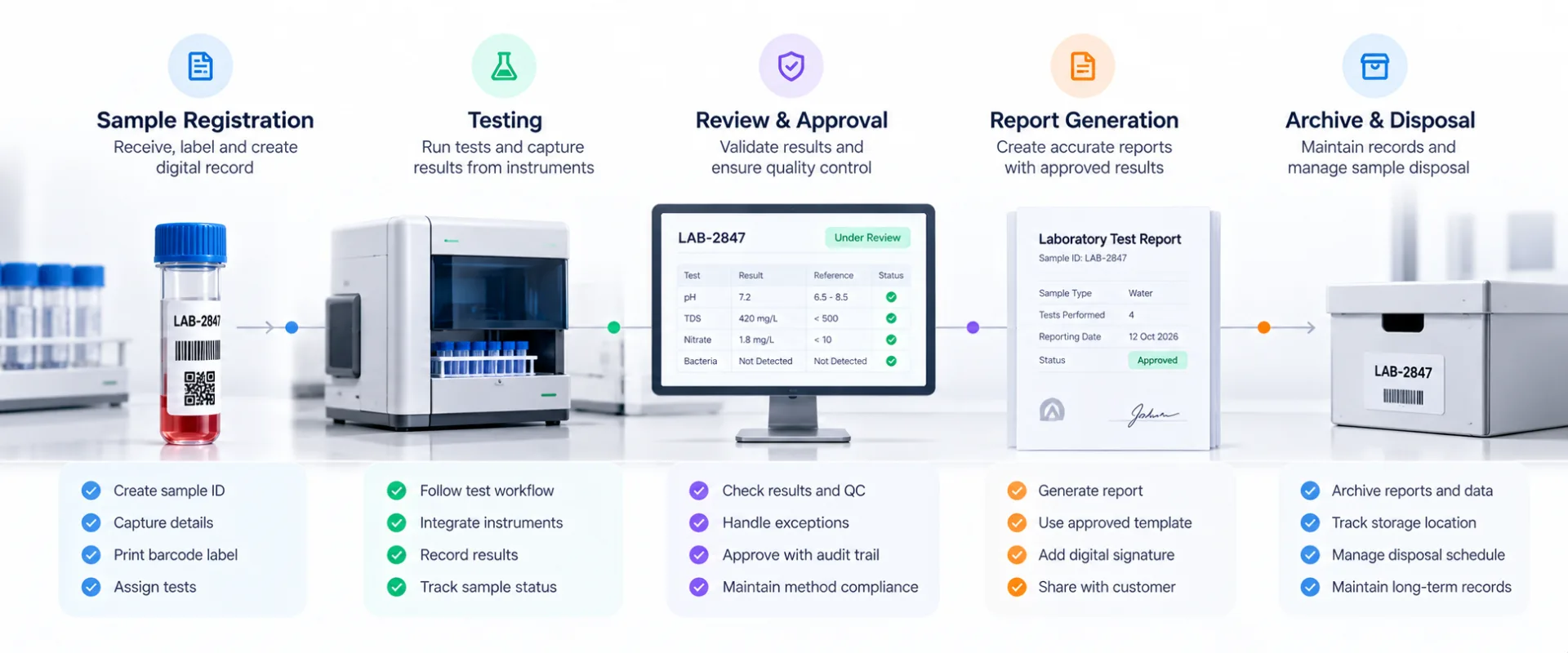
At reception
The sample receives a unique identifier.
The system records the customer, sample type, collection information, received condition, requested tests, and any relevant chain-of-custody details.
A barcode label links the physical container to its digital record.
During testing
A technician scans the sample, opens the assigned worklist, and records results.
Where instruments support integration, measurements may be imported rather than typed manually.
During review
A reviewer checks results, applicable quality controls, calculations, and exceptions before authorizing the report.
At release
The system generates a report using approved templates and records who authorized it.
One sample record connects the entire journey.
The US Environmental Protection Agency describes LIMS as a way to manage samples, instruments, standards, data transfer, and laboratory reporting.
LIMS, LIS or ELN: Which One Do You Need?
These terms are frequently used together, but they describe different priorities.
| Software | Primary Focus | Typical Use |
|---|---|---|
| LIMS | Sample lifecycle and testing workflows | Environmental, industrial, pharmaceutical, food testing |
| LIS | Clinical laboratory operations and patient-linked results | Hospitals and diagnostic laboratories |
| ELN | Recording experiments, observations, and research | Research and development laboratories |
The boundaries are not absolute.
Modern platforms may combine capabilities from more than one category.
Choose based on the information you manage
A clinical laboratory may need patient identifiers, physician orders, reference ranges, and interfaces with hospital systems.
A food testing laboratory may need batch traceability, test specifications, certificates of analysis, and customer reporting.
A research laboratory may prioritize experimental procedures, observations, datasets, and collaboration.
The mistake is choosing software based on its label without checking whether it supports the laboratory's real workflow.
The Features That Prevent Expensive Mistakes
Not every useful feature needs to appear in the first release.
But some controls become fundamental as sample volume grows.
Sample tracking and chain of custody
A sample's location, status, custody transfers, and handling history should be recorded where required.
Barcode or QR-code scanning can reduce manual lookup.
Test assignment and worklists
The system should know which tests are requested, who is qualified to perform them, which methods apply, and what work is pending.
Instrument integration
Connected instruments can reduce transcription work.
However, integration needs to preserve measurement context, units, instrument identifiers, and relevant raw data.
Result validation
The system can flag missing values, out-of-range measurements, failed quality controls, or unexpected results.
Flags should initiate review rather than silently changing scientific results.
Equipment and calibration records
Laboratories may need to track maintenance, calibration status, instrument availability, and service history.
Reporting and customer access
Approved reports can be generated consistently and made available through a secure customer portal.
A practical requirements checklist
- Included: Unique sample identifiers and barcode labels
- Included: Sample status and location history
- Included: Configurable tests, methods, and specifications
- Included: Technician assignments and worklists
- Included: Result review and approval
- Included: Instrument and calibration records
- Included: Role-based access and audit history
- Included: Report generation and controlled release
- Included: Data export, backup, and recovery
Start by separating essential controls from features that can wait.
For example, a small industrial testing laboratory may need sample tracking and report approval immediately, while advanced customer billing and analytics can be introduced later.
Your Instruments Are Part of the Software Problem
A laboratory may operate several instruments from different manufacturers.
One exports CSV files.
Another produces XML.
A third stores results in proprietary software.
A fourth has no supported automated export.
Connecting these devices is often one of the most challenging parts of LIMS development.
A realistic integration design
The system should reject or quarantine data it cannot reliably associate with a sample.
For example, a result with an unknown sample identifier should not automatically be attached to the nearest matching record.
Warning
Instrument integration is not simply file importing. Incorrect units, missing identifiers, duplicate records, or altered precision can create serious reporting errors.
A robust implementation needs test cases covering malformed files, duplicate imports, instrument failures, interrupted transfers, and unexpected values.
What NIST Learned About Laboratory Data
A useful real-world reference comes from the US National Institute of Standards and Technology (NIST).
In its technical report A Roadmap for LIMS at NIST Material Measurement Laboratory, NIST examines the need for laboratory data systems that connect instruments, samples, data repositories, analysis, and sharing.
The roadmap emphasizes that a laboratory information system is not simply a database. It involves the movement, organization, preservation, and use of scientific data.
Source: NIST Technical Note 2216.
The report is a planning and architecture reference, not evidence that a particular custom LIMS implementation produced a quantified financial return.
The lesson for commercial laboratories
When developing laboratory software, consider what happens to data beyond the immediate test.
Can an authorized employee find the original result two years later?
Can a reviewer identify which instrument produced it?
Can the laboratory export data if it changes software providers?
Can historical results be linked to their methods and relevant metadata?
Long-term data accessibility should influence the architecture from day one.
Compliance Is a Design Requirement, Not a Plugin
Laboratory software often supports work governed by accreditation standards, customer contracts, and industry regulations.
For testing and calibration laboratories, ISO/IEC 17025:2017 addresses competence, impartiality, and consistent operation.
ISO confirms that the standard remains current.
Source: ISO/IEC 17025.
A LIMS may help manage records and support controlled workflows, but software alone does not establish accreditation.
What should be designed carefully?
Access control: Only authorized personnel should perform restricted actions.
Record integrity: Changes should not silently overwrite important historical information.
Approval workflows: Results should follow the laboratory's review and authorization requirements.
Retention: Records must remain available for the periods required by applicable obligations.
Validation and testing: The organization should establish evidence that the software performs its intended functions reliably.
For laboratories subject to relevant US FDA regulations, electronic records and signatures may also raise 21 CFR Part 11 considerations.
The FDA's guidance explains that applicability depends on the underlying recordkeeping requirements and how electronic records are used.
Source: FDA Part 11 Scope and Application.
Note
Compliance requirements vary by laboratory type, jurisdiction, and intended use. Regulatory specialists and laboratory quality personnel should be involved when defining system requirements.
Calculate the Cost of Manual Laboratory Work
A custom LIMS is an investment.
The business case should begin with measurable inefficiencies rather than a generic promise of automation.
Consider a hypothetical laboratory processing 4,000 samples per month.
Suppose employees spend an average of three minutes per sample on manual registration, repeated data entry, or record lookup.
That represents:
4,000 samples × 3 minutes = 200 hours per month.
At an illustrative fully loaded labor cost of ₹400 per hour, the equivalent workload is ₹80,000 per month.
If improved workflows reduce that administrative effort by half, the capacity released would be equivalent to ₹4.8 lakh annually.
This is a hypothetical calculation, not an observed customer result or guaranteed cash saving.
The laboratory may use the saved capacity to process more samples, improve review quality, or reduce overtime.
Other costs worth measuring
- Repeat tests caused by record or labeling errors
- Delayed reports and missed turnaround targets
- Time spent preparing audit evidence
- Manual instrument data transcription
- Customer support inquiries about sample status
- Time spent correcting reports
The strongest ROI analysis compares these operational costs with development, integration, hosting, maintenance, training, and validation expenses.
What Does Custom LIMS Development Cost?
The cost depends on laboratory complexity, number of instruments, sample volume, workflow requirements, and applicable quality or regulatory controls.
Illustrative 2026 budgets in India
| Scope | Estimated Development Cost |
|---|---|
| Basic sample tracking and reporting | ₹5–10 lakh |
| LIMS with testing workflows and approvals | ₹10–22 lakh |
| Multi-instrument, multi-location LIMS | ₹22–45 lakh |
| Complex regulated enterprise LIMS | ₹45 lakh–₹1 crore+ |
These are illustrative planning ranges, not independently verified market averages or fixed quotations.
A laboratory with ten straightforward instruments may be easier to integrate than one with three legacy instruments using undocumented formats.
Build or buy?
Choose an established LIMS when its supported workflows, instrument integrations, licensing, and deployment options meet your needs.
Consider custom development when specialized testing processes, unique equipment, customer reporting requirements, or existing system integrations make standard products difficult or costly to adapt.
A hybrid approach is also possible: retain an existing LIMS and build custom portals, automation, or integrations around it.
Start with one complete workflow
For a first implementation, choose one sample category and develop its complete journey:
- Registration and labeling
- Test assignment
- Result entry or import
- Review and approval
- Report generation
- Record retrieval
Test the workflow with actual laboratory users and representative data before expanding to other sample types or facilities.
How Software Studio Pro Can Help
Software Studio Pro develops custom web applications, business platforms, dashboards, backend services, and system integrations.
For laboratories, a custom software project can include sample tracking, technician worklists, instrument data integration, result review, report generation, and customer portals.
We recommend beginning with the workflows where your laboratory loses the most time or faces the greatest operational risk.
Then we design the application around your laboratory's methods, users, equipment, and data requirements.
The right laboratory software should make your results easier to trust, trace, and deliver.
FAQ
What is a Laboratory Information Management System?
A LIMS is software used to manage laboratory samples, testing workflows, results, instruments, and associated records throughout their lifecycle.
What is the difference between LIMS and LIS?
LIMS generally emphasizes sample management and testing workflows, while LIS commonly focuses on clinical laboratory operations and patient-associated results. Some products combine both sets of capabilities.
Can custom LIMS integrate with laboratory instruments?
Yes, when the instruments provide suitable data interfaces or supported exports. Integration feasibility depends on device capabilities, file formats, vendor documentation, and validation requirements.
How much does custom LIMS software cost?
Illustrative budgets in India may start around ₹5–10 lakh for basic sample tracking and reporting. Complex multi-instrument or regulated systems can cost substantially more.
Does LIMS help with ISO 17025?
A LIMS can support controlled records, sample traceability, result review, and reporting processes relevant to a laboratory's management system. It does not automatically provide ISO/IEC 17025 accreditation.
How long does LIMS development take?
A focused initial system may take several months. Multiple instrument integrations, data migration, regulated validation, and complex workflows can extend the timeline.
Can a laboratory migrate from Excel to LIMS?
Yes. Migration typically involves cleaning sample records, standardizing test names and units, mapping historical data, and verifying that imported information remains accurate and traceable.
Should a small laboratory build custom LIMS?
Not necessarily. Smaller laboratories should compare ready-made solutions with custom development based on their workflows, budgets, instrument needs, and long-term operating costs.
Ready to bring your business idea to life? Contact us today and let's build something amazing together!
Contact Us
READ MORE BLOGS
Custom Production Planning Software Development Guide
Published on - 28th October, 2026
Custom Subscription Billing Software Development Guide
Published on - 28th October, 2026
Custom Travel Agency Booking Software Development Guide
Published on - 28th October, 2026
Custom Legal Case Management Software: A Practical Guide
Published on - 28th October, 2026
Custom Gym Management Software: Features, Cost & ROI
Published on - 28th October, 2026