BLOG ON
Manufacturing Execution System (MES) Development
PUBLISHED ON - 26th October, 2026 · 10 min read
PUBLISHED BY

Aditya Prem Sharma
Product Specialist
Manufacturing Execution System (MES) Development
Your ERP says 5,000 units are scheduled for production today.
At 11 AM, the production manager asks how many units are actually complete.
The supervisor checks three production lines, calls the quality department, and opens yesterday's spreadsheet. By the time the numbers are consolidated, another machine has stopped.
The ERP still shows the original production plan.
The factory is moving, but management is making decisions using information that is already outdated.
This is where a Manufacturing Execution System (MES) becomes valuable.
An MES connects production orders, machines, operators, materials, and quality records so manufacturers can see what's happening on the shop floor and respond before small disruptions become expensive problems.
ERP tells your business what should be manufactured. MES helps your factory execute, track, and verify what is actually being manufactured.
A well-designed MES doesn't necessarily replace your ERP or industrial control systems. It connects the information between business planning and factory operations.
The Production Order Nobody Can Track
Imagine a manufacturing company receiving an order for 10,000 components.
The ERP creates the production order and assigns a delivery date.
But once manufacturing begins, the information becomes fragmented.
Follow the order through the factory
| Production Stage | What Management Needs to Know | Common Information Gap |
|---|---|---|
| Order released | Has production started? | Order status updated manually |
| Materials issued | Are the right materials available? | Stock and shop-floor records differ |
| Machine setup | Is the line ready? | Setup delays aren't recorded |
| Production running | How many good units are complete? | Output reported at shift end |
| Quality inspection | How many units passed? | Results stored separately |
| Rework | Which units need correction? | Rework history is incomplete |
| Production completed | What is ready for dispatch? | ERP updated hours later |
The problem isn't always a lack of data.
Factories often generate enormous amounts of information.
The problem is that information arrives too late, in different formats, or without enough context to support decisions.
A familiar factory-floor conversation
Production manager: "Why is Line 3 behind schedule?"
Supervisor: "The machine stopped twice."
Manager: "For how long?"
Supervisor: "I'll check the register."
Manager: "Was it a machine fault or a material shortage?"
Supervisor: "We need to ask maintenance."
A good MES won't prevent every breakdown.
It can, however, make the answers easier to find.
MES vs ERP: Who Does What?
Manufacturers frequently ask whether they need an MES when they already have SAP, Oracle, Microsoft Dynamics, or another ERP.
The answer depends on how much visibility and control the existing system provides at the production-execution level.
The responsibilities are different
<escape></escape>
| ERP | MES |
|---|---|
| Customer and sales orders | Shop-floor work orders |
| Material requirements planning | Material consumption tracking |
| Procurement and purchasing | Production execution |
| Inventory and financial records | Work-in-progress visibility |
| Business-level production planning | Operator instructions |
| Cost accounting | Quality and defect recording |
| Delivery and business reporting | Machine and production events |
An MES is typically positioned between business planning and industrial operations.
The ISA-95 standard describes this relationship through different levels of enterprise and manufacturing activities.
In that model, manufacturing operations management sits at Level 3, while ERP-related business planning is associated with Level 4.
Does every factory need a full MES?
No.
A small workshop may only need digital production orders and shift reporting.
A factory with multiple lines, complex routing, traceability requirements, and frequent quality issues may need a more comprehensive system.
The right starting point is the operational gap, not the software category.
What Should a Production Manager See?
Instead of starting with a list of 50 features, start with the questions your team needs answered during every shift.
The shop-floor visibility scorecard
| Question | Useful MES Capability | Business Value |
|---|---|---|
| What is running now? | Live production status | Faster coordination |
| Are we meeting the target? | Planned vs actual output | Earlier corrective action |
| Why did a line stop? | Downtime event recording | Better root-cause analysis |
| Which batch has a defect? | Lot and serial traceability | Targeted investigation |
| Are materials available? | Material consumption tracking | Fewer unexpected shortages |
| What is waiting for inspection? | Quality workflow | Reduced handoff delays |
| Which orders are at risk? | Production exception alerts | More reliable delivery planning |
A useful dashboard has three layers
For operators
Show the current job, work instructions, required materials, production count, and relevant quality checks.
For supervisors
Show line status, output, downtime, pending approvals, and unresolved production issues.
For management
Show production performance, order progress, quality trends, utilization, and recurring bottlenecks.
These interfaces should share reliable information while presenting only what's relevant to each role.
One important design principle
Don't ask operators to enter information that the system can reliably collect from an existing machine or approved integration.
But don't assume every machine supports automatic data collection either.
Older equipment may require manual inputs, gateway devices, or additional integration work.
Tip
Start by capturing accurate production events. Advanced analytics becomes useful only after your team trusts the underlying data.
Real MES Projects and Their Results
Let's look at what manufacturers have achieved through real production digitalization projects.
These are external case studies, not Software Studio Pro projects.
Scanfil: Connecting Production Across the Factory
Scanfil is a global electronics manufacturing company.
At its Suzhou facility in China, the company needed better traceability, production visibility, and quality management.
Its existing ERP couldn't provide complete end-to-end tracking of materials, components, production steps, and finished products.
Scanfil implemented a manufacturing operations management solution using Siemens technology.
Published implementation scale
<escape></escape>
| Measure | Reported Figure |
|---|---|
| Digitally connected machines | Approximately 236 |
| Product routings available | 2,189 |
| PCB panels produced in 2022 | 2.67 million |
| Individual PCBs produced in 2022 | 10.5 million |
| Average new-product introduction time | Reduced from 40 to 9 hours |
The reported reduction in new-product introduction time is particularly relevant to manufacturers that frequently switch between product configurations.
The company also described improvements in material traceability, production changeovers, and quality control.
Rockwell Automation: Standardizing Factory Operations
Rockwell Automation also applied MES technology to its own manufacturing operations.
The company standardized production processes across multiple facilities using a connected ERP and MES environment.
Its published transformation results included:
- Inventory reduced from 120 days to 82 days.
- Manufacturing lead times reduced by 50%.
- An estimated 4–5% annual productivity improvement.
- Supply-chain delivery performance reaching up to 96%.
These were results of a broader manufacturing transformation involving ERP consolidation, MES deployment, and operational changes. They should not be attributed exclusively to MES software.
What these examples teach us
Large manufacturers don't gain value simply by installing dashboards.
They improve the way production information is collected, shared, validated, and acted upon.
For a smaller factory, the same principle may begin with one production line and a handful of essential measurements.
The KPIs That Reveal Production Problems
Manufacturing software becomes much more valuable when it helps teams understand why performance changes.
One of the best-known production measurements is Overall Equipment Effectiveness (OEE).
OEE combines three factors:
Availability: How much planned production time was actually available for operation?
Performance: How efficiently did equipment run compared with its ideal rate?
Quality: How much of the output met quality requirements?
Example OEE calculation
Suppose a production line has:
| Factor | Illustrative Value |
|---|---|
| Availability | 90% |
| Performance | 85% |
| Quality | 95% |
OEE = 0.90 × 0.85 × 0.95 = 72.7%
That doesn't automatically mean the factory is performing badly.
Different production environments have different constraints, and the underlying definitions must be consistent.
What happens when performance improves?
Consider an illustrative scenario where better downtime analysis and operational changes increase availability while the other factors remain unchanged.
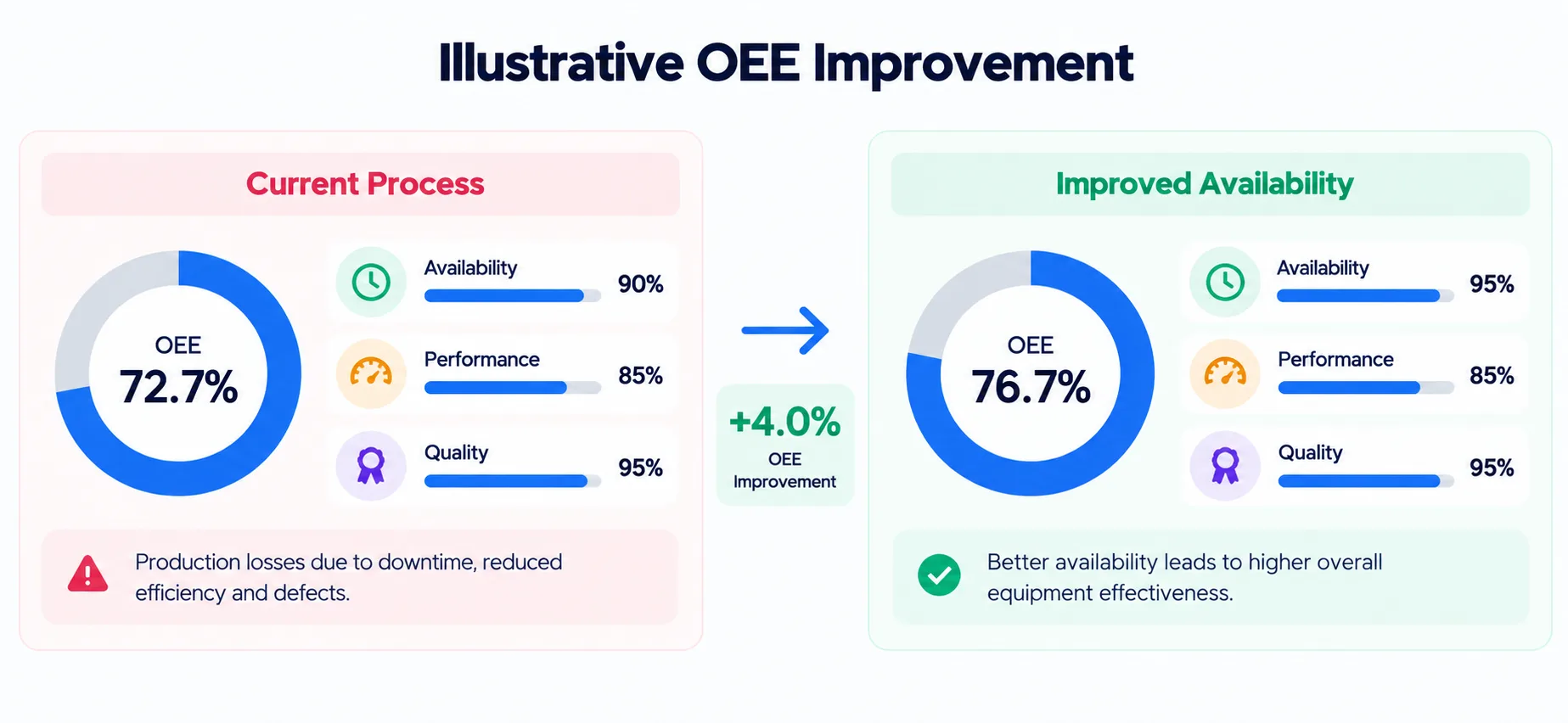
The second scenario assumes availability rises from 90% to 95%.
The software doesn't create that improvement by itself.
It can help identify recurring losses so maintenance, production, and management teams can address them.
Don't measure OEE alone
Other useful MES metrics include:
- First-pass yield
- Scrap and rework rates
- Production cycle time
- Changeover duration
- Unplanned downtime
- Schedule adherence
- Work-in-progress aging
- Order completion accuracy
Choose measurements based on your actual manufacturing objectives.
What Makes MES Development Difficult?
MES projects are different from ordinary business dashboard development.
They must work within a real production environment.
That creates several important challenges.
Legacy machine connectivity
Some equipment exposes data through industrial protocols or vendor interfaces.
Other machines may not support convenient digital integration.
Your implementation may require specialist industrial automation support.
Production cannot simply stop for deployment
Manufacturers cannot always afford extended downtime while software is installed or tested.
Changes may need to be introduced gradually, during planned maintenance windows, or alongside existing processes.
Product and batch traceability
A production system may need to connect finished products with materials, batches, machines, operators, inspections, and timestamps.
Incomplete traceability can make defect investigations significantly harder.
Shop-floor usability
Operators need interfaces that are quick, clear, and practical.
A tablet screen with dozens of complicated forms may slow production instead of helping it.
Data accuracy and recovery
Industrial systems can experience connectivity interruptions.
The software should account for missing events, delayed updates, duplicate records, and controlled recovery.
Security and safety boundaries
An MES may interact with operational technology, but monitoring equipment is different from controlling it.
Warning
Never treat machine-control integrations like ordinary website APIs. Changes affecting equipment operation, safety systems, or production-critical controls require qualified industrial engineering involvement, testing, and appropriate safeguards.
Software developers can build dashboards, integrations, and workflows, while qualified automation specialists handle the relevant industrial control requirements.
Custom MES vs Commercial MES Platforms
Should you build a custom MES or use an established platform such as Siemens Opcenter or Rockwell FactoryTalk?
The answer depends on your manufacturing environment.
Commercial MES platforms
Established platforms can provide mature capabilities for production execution, quality, traceability, and industry-specific workflows.
They may be preferable when your operations align with their supported capabilities and you have the resources for implementation.
Custom MES development
Custom software may be attractive when your requirements are narrower or unusually specific.
For example, you may only need production tracking, downtime reporting, and ERP synchronization across three lines.
Building a focused application can sometimes be more practical than implementing a much larger platform.
Compare the options
| Consideration | Commercial MES | Custom MES |
|---|---|---|
| Standard production features | Often extensive | Built to scope |
| Initial deployment | Depends on configuration | Depends on development |
| Industry-specific capabilities | Platform-dependent | Requires design and expertise |
| Legacy equipment integration | Connector-dependent | Can be tailored |
| User interface | Platform framework | Fully customizable |
| Licensing | Vendor-specific | Depends on solution |
| Maintenance | Vendor and implementation partner | Development team/partner |
| Long-term flexibility | Platform-dependent | Greater ownership and control |
A third option: Extend what you already use
Sometimes the best solution isn't replacing the existing MES.
A manufacturer might need a modern production dashboard, operator tablet application, or integration service connected to its current systems.
That can be a lower-risk way to solve a focused problem.
Choose the smallest reliable solution that addresses the production issue without introducing unnecessary operational risk.
MES Development Cost and Rollout Strategy
MES budgets depend heavily on scope, factory conditions, equipment integrations, and validation requirements.
The following are illustrative 2026 software-development planning ranges in India, not verified market averages or fixed quotations.
| Project Scope | Indicative Budget |
|---|---|
| Production tracking dashboard | ₹5–10 lakh |
| Digital work orders and shift reporting | ₹10–18 lakh |
| MES with quality and traceability | ₹18–35 lakh |
| Multi-line MES with ERP integration | ₹35–70 lakh |
| Enterprise multi-plant MES | ₹70 lakh–₹2 crore+ |
Industrial hardware, sensors, gateways, PLC integration, software licenses, validation, and plant-specific deployment costs may be additional.
For safety-critical or heavily regulated production, specialist engineering and formal validation can materially increase the budget.
Start with a single production problem
Instead of digitizing the entire factory immediately, select one issue.
For example:
"We only discover production losses after the shift ends."
Build an initial solution that records production output and downtime events accurately.
Then measure whether supervisors can respond faster and identify recurring causes.
A practical rollout sequence
Discovery
Document production processes, equipment, data sources, and operational constraints.
Pilot design
Choose one production line and a small set of measurable goals.
Initial development
Build the necessary operator interface, production records, and reporting tools.
Integration testing
Validate data exchange with relevant ERP, machine, or gateway systems.
Controlled deployment
Run the system alongside existing processes where appropriate.
Operational validation
Compare software records against actual production results.
Expansion
Add more lines, quality workflows, traceability, maintenance integration, and analytics.
Before approving a wider rollout
- Included: Production events are recorded accurately.
- Included: Operators can use the system without disrupting work.
- Included: Downtime reasons follow agreed definitions.
- Included: Production counts reconcile with physical output.
- Included: Failed integrations are visible and recoverable.
- Included: Quality records are traceable.
- Included: User permissions match operational responsibilities.
- Included: Existing safety systems remain appropriately isolated.
- Included: Plant personnel have approved the workflows.
- Included: Management can measure improvements against a baseline.
The pilot should demonstrate operational value before the business commits to a larger implementation.
How Software Studio Pro Can Help Manufacturers
Many manufacturers already have an ERP, production equipment, and experienced operational teams.
What they may lack is a practical software layer that brings relevant production information together.
At Software Studio Pro, we develop custom web applications, mobile and desktop software, dashboards, APIs, and enterprise integrations.
What we can build
Production monitoring dashboards
Track work orders, production output, downtime, and operational performance.
Operator web and tablet applications
Provide digital work instructions, production forms, and shift reporting.
Quality management workflows
Record inspections, defects, approvals, and corrective actions.
Production traceability systems
Connect relevant materials, batches, production records, and finished products.
ERP integration services
Synchronize approved production information with supported business systems.
Desktop applications for industrial environments
Build operator-facing desktop utilities and interfaces where suitable, working with qualified equipment-integration specialists when required.
Management reporting
Create dashboards for production efficiency, scrap, downtime, and order progress.
Ongoing software maintenance
Support the application as production workflows and business requirements evolve.
You bring the manufacturing expertise
You understand your products, machines, quality requirements, and factory operations.
We bring the software engineering expertise to turn approved requirements into usable applications.
For industrial control, machine safety, and specialized equipment interfaces, we work within the boundaries of the appropriate engineering expertise and validation requirements.
Where to begin
You don't need a complete smart factory transformation to get started.
Choose one measurable problem.
Maybe your production reports arrive too late.
Maybe defects are difficult to trace.
Maybe supervisors can't see which orders are falling behind.
Build around that problem, validate the result, and expand when the value is clear.
The goal of MES development isn't to collect more factory data. It's to help the people running your factory make better decisions with reliable information.
FAQ
What is a Manufacturing Execution System?
A Manufacturing Execution System is software used to manage, track, and document manufacturing activities during production.
What is the difference between MES and ERP?
ERP primarily supports business planning and enterprise processes, while MES focuses on production execution and shop-floor operations.
Can MES integrate with SAP?
Yes, depending on the SAP products, available interfaces, integration architecture, and required workflows.
Can a small factory use MES software?
Yes. Smaller factories may benefit from focused production tracking, digital work orders, and downtime reporting without implementing a full enterprise MES.
Does MES require IoT sensors?
Not always. Data can come from operator inputs, existing systems, machine interfaces, or suitable sensors, depending on the application.
What is OEE in manufacturing?
Overall Equipment Effectiveness measures the combined effects of equipment availability, performance, and production quality.
Can MES reduce manufacturing defects?
MES can support defect tracking, process verification, traceability, and faster identification of quality problems. Actual defect reductions depend on the operational improvements made.
How much does custom MES development cost?
A focused production tracking application in India might be budgeted around ₹5–10 lakh, while complex multi-line or enterprise MES projects can require ₹35 lakh to ₹2 crore or more. These are illustrative planning estimates.
How long does MES development take?
A focused pilot may take approximately three to six months. Larger implementations with complex equipment integrations and validation requirements can take significantly longer.
Can MES work with older manufacturing machines?
Sometimes. Integration feasibility depends on equipment capabilities, available interfaces, and the involvement of suitable industrial automation specialists.
Is custom MES better than Siemens Opcenter?
Not necessarily. Established MES platforms can be preferable for comprehensive manufacturing requirements. Custom development can make sense for focused or highly specialized workflows.
What should a manufacturer digitize first?
Start with a measurable operational problem such as delayed production reporting, downtime visibility, work-order tracking, or quality documentation.
Ready to bring your business idea to life? Contact us today and let's build something amazing together!
Contact Us
READ MORE BLOGS
Custom Field Service Management Software Development
Published on - 26th October, 2026
Custom B2B Order Management System Development
Published on - 26th October, 2026
Custom Healthcare Practice Management Software: What Clinics Really Need
Published on - 26th October, 2026
Custom Warehouse Management Software Development
Published on - 26th October, 2026
Enterprise Workflow Automation Across ERP and CRM
Updated on - 23rd October, 2026